
Frozen in Time: Can Science Actually Bring the Dead Back to Life?
The Science of Turning a Body Into Glass
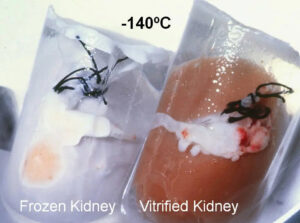
Vitrification is a process in which biological tissue is cooled until it becomes a solid without forming conventional ice crystals. Instead of allowing water to freeze, technicians introduce high concentrations of cryoprotective agents (CPAs), chemical compounds that interfere with ice formation. These substances partially replace the water inside cells and change how the remaining liquid behaves at extremely low temperatures.
When cooling happens under the right conditions, the solution enters a glass-like state: rigid, molecularly disordered and capable of remaining stable at cryogenic temperatures. Theoretically, this preserves the physical structures that would otherwise be destroyed by ordinary freezing.
The technique already has practical applications in medicine. Embryos, reproductive cells and certain biological samples can be successfully cryopreserved and later returned to functional conditions. Cryonics attempts to apply the same underlying principles to something incomparably more complicated: an entire human body, including its brain. And that is where the chemistry becomes particularly difficult.
Cryoprotectants are potentially toxic. The concentrations necessary to prevent ice formation can interfere with cellular metabolism, damage proteins and disrupt the very biological processes preservation is supposed to protect. Increasing the concentration reduces the risk of ice formation but increases chemical stress on the tissue. Finding the right balance is one of the biggest obstacles in cryopreservation research.
A remarkable study published in Proceedings of the National Academy of Sciences (PNAS) in March 2026 demonstrated just how narrow this balance can be. Researchers successfully vitrified 350-micrometer-thick slices of mouse hippocampus, a brain region essential for learning and memory, and subsequently recovered measurable electrical activity.
At a cryoprotectant concentration of 59%, the researchers observed the recovery of synaptic transmission, demonstrating that neurons could once again communicate after vitrification. However, increasing the concentration to 65% produced substantially greater mitochondrial dysfunction. Mitochondria, responsible for generating the energy cells need to function, showed markedly reduced respiratory activity. The experiment revealed a fundamental engineering dilemma: the chemicals needed to protect tissue from ice can themselves compromise its biological functionality.
There is another important detail. These were extremely thin mouse brain slices, not intact human brains. Preserving a small piece of neural tissue under carefully controlled laboratory conditions is a significant achievement, but scaling the process to an entire organ introduces enormous additional challenges.