
Why Is Water So Weird? The 70+ Anomalies That Make Life Possible
Could water actually be two different liquids?
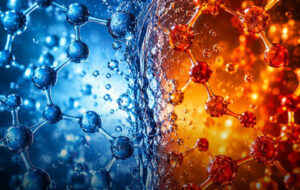
Despite decades of research, scientists are still investigating what happens inside liquid water at the molecular level. One particularly intriguing explanation for its unusual behaviour is the two-liquid hypothesis.
According to this theory, deeply supercooled water can exist in two distinct liquid states: a high-density liquid and a low-density liquid. The difference lies in how its molecules arrange themselves. High-density water has a more compact molecular structure, while low-density water contains a more open, tetrahedral hydrogen-bond network. The hypothesis suggests that these two structures are connected by a liquid-liquid phase transition, ending at a second critical point. Fluctuations between the two arrangements could help explain several of water’s unusual properties, including its rapidly increasing heat capacity and compressibility as temperatures approach the supercooled region.
For decades, investigating this possibility experimentally was extraordinarily difficult. Water tends to crystallise into ice before researchers can examine the relevant temperatures in detail. That changed significantly in March 2026. A study published in Science reported experimental evidence of a liquid-liquid critical point in supercooled water. Researchers used ultrafast infrared laser pulses to heat different forms of amorphous ice, then examined the resulting liquid states using X-ray scattering. They observed structural fluctuations and a sharp increase in heat capacity around 210 kelvin, consistent with the predicted critical behaviour.
Further research published in Nature Physics in June 2026 provided additional evidence for two distinct local structures in liquid water. These findings bring scientists closer to understanding why water behaves so differently from other liquids.